Winter Nourishment & Spring Renewal | TCM Acupuncture St Albans
CN
Discover how Traditional Chinese Medicine views winter, spring, Yin and Yang, the 24 Solar Terms and seasonal wellbeing at Four Pillars Acupuncture in St Albans.
Nurturing the First Spark of Yang — Following Nature's Rhythm Through Traditional Chinese Medicine
Winter is not simply the end of a growing season. It is also where the next season's growth begins.
In nature, the most important changes are not always visible. Beneath frozen soil, roots remain active, seeds lie dormant, and trees quietly prepare for the arrival of spring.
Traditional Chinese Medicine (TCM) offers a similar perspective on human health. Rather than looking only at symptoms, it encourages us to consider the conditions that support the body's ability to function, adapt and recover.
The transition from winter to spring provides a beautiful opportunity to explore this philosophy.
The Winter Solstice: When Yang Begins to Return
In traditional Chinese philosophy, the Winter Solstice marks an important turning point.
It is the shortest day of the year, when Yin reaches its seasonal peak and Yang begins its gradual return. This principle is known as 冬至一陽生 —
"At the Winter Solstice, the first Yang begins to emerge."
Imagine a small flame beginning to glow within the body.
Although the weather remains cold, daylight gradually increases. Nature has not yet awakened fully, but the process of renewal has already begun.
In TCM, Yang is traditionally associated with warmth, activity, movement and transformation. Yin is associated with nourishment, rest, cooling and preservation.
Both are essential.
The aim is not simply to increase Yang, but to maintain an appropriate relationship between activity and rest, warmth and nourishment.
Just as a young flame needs protection rather than excessive fuel, the early stages of renewal invite us to care for our energy without exhausting it.
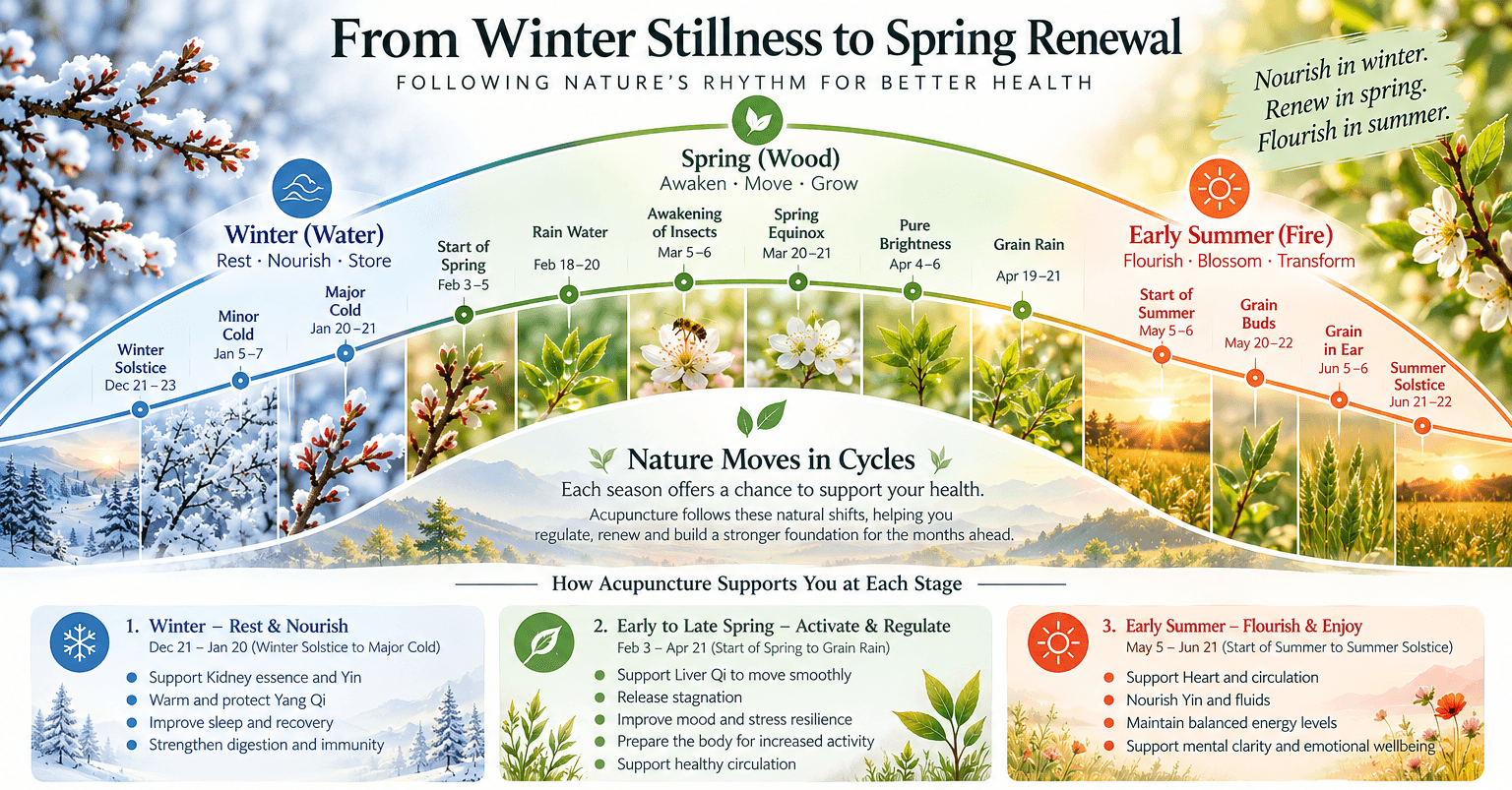
From Water to Wood to Fire: The Rhythm of the Seasons
The Five Element tradition describes seasonal change through interconnected phases.
Winter — Water: Rest, Nourish and Preserve
Winter is associated with the Kidney system in TCM and the conservation of Essence (Jing).
It is traditionally a time to prioritise adequate rest, nourishing food, warmth and recovery.
Spring — Wood: Awaken, Move and Grow
Spring is associated with the Liver system and the smooth movement of Qi.
As daylight increases, nature becomes more active. New shoots emerge, branches extend and growth resumes.
In daily life, this can be a reminder to gradually increase movement, establish healthy routines and pay attention to emotional wellbeing.
Summer — Fire: Flourish and Express
Summer is associated with the Heart system, warmth, connection and activity.
The growth that began quietly during winter becomes visible in summer.
These Five Element relationships are part of a traditional medical philosophy, rather than a literal description of biological organs or scientifically established seasonal energy changes.
Nevertheless, they offer a useful way to reflect on the importance of adapting our routines throughout the year.
The 24 Solar Terms: Understanding Nature's Gradual Changes
Traditional Chinese calendars divide the year into 24 Solar Terms, marking seasonal changes in sunlight, climate and agricultural activity.
Between the Winter Solstice and early summer, several important stages illustrate nature's gradual transformation:
- Winter Solstice (around 21 December): The beginning of increasing daylight.
- Minor Cold and Major Cold (January): A period traditionally associated with conserving warmth and nourishment.
- Start of Spring (around 4 February): The first signs of seasonal transition.
- Rain Water (around 19 February): A reminder of moisture and emerging growth.
- Awakening of Insects (around 5 March): Nature begins to stir.
- Spring Equinox (around 20 March): Day and night approach equal length.
- Pure Brightness and Grain Rain (April): New leaves, blossoms and growth become more established.
- Start of Summer (around 5 May): A transition towards greater warmth and activity.
The exact dates vary slightly each year.
These stages remind us that renewal is not a single event. It is a gradual process shaped by changing conditions.
Healing Is Sometimes Like Gardening
A gardener does not wait until summer to care for a tree.
During winter and early spring, they protect the roots, nourish the soil, manage water, prune when appropriate and prepare the conditions for new growth.
I recently noticed fresh green shoots emerging from an older branch that appeared dry and damaged.
It reminded me of something important about health:
A body that has changed is not necessarily a body that has lost every possibility for improvement.
Persistent pain, fatigue, altered sensation or long-term health conditions can sometimes leave people feeling that their bodies are permanently damaged.
Some structural changes, such as advanced joint degeneration or significant nerve injury, cannot simply be reversed. Acupuncture cannot promise to regenerate these structures.
However, structural changes do not always determine every aspect of pain, movement, comfort or quality of life.
There may still be opportunities to improve function, develop healthier routines, manage symptoms and support adaptation.
Just as we would not care for a struggling tree by looking only at one damaged leaf, it can be helpful to consider the wider conditions influencing a person's health.
Looking Beyond Symptoms: The Four Pillars Clinical Approach
At Four Pillars Acupuncture in St Albans, my approach is based on three interconnected areas:
1. Presenting symptoms
Understanding the pain, discomfort, fatigue, sleep disturbance or other concerns affecting daily life.
2. Nervous system and physical function
Considering sensory responses, movement, stress, sleep and the ways the body responds to ongoing symptoms.
3. Underlying patterns
Exploring wider TCM patterns alongside relevant lifestyle, physical and health factors that may contribute to persistent or recurring difficulties.
Acupuncture may be considered as one component of an individualised care plan, alongside appropriate medical care, nutrition, movement, rest and lifestyle adjustments.
The purpose is not to promise that every condition can be cured, but to support comfort, function and wellbeing where possible.
Nourish the Roots Today. Support New Growth Tomorrow.
The transition from winter to spring reminds us that meaningful change often begins before we can see it.
A tree does not blossom because we pull on its branches. It grows when its underlying conditions are suitable.
Likewise, caring for our health is not always about doing more. Sometimes it means resting better, eating regularly, moving appropriately, managing stress or seeking support when symptoms persist.
Don't just ask, "How do we treat this symptom?" Ask, "Why might it be happening, and what conditions could help?"
The blossom we hope to see in summer begins with the care we give in winter.
Nourish the roots. Support new growth. 🌱
Four Pillars Acupuncture | St Albans